
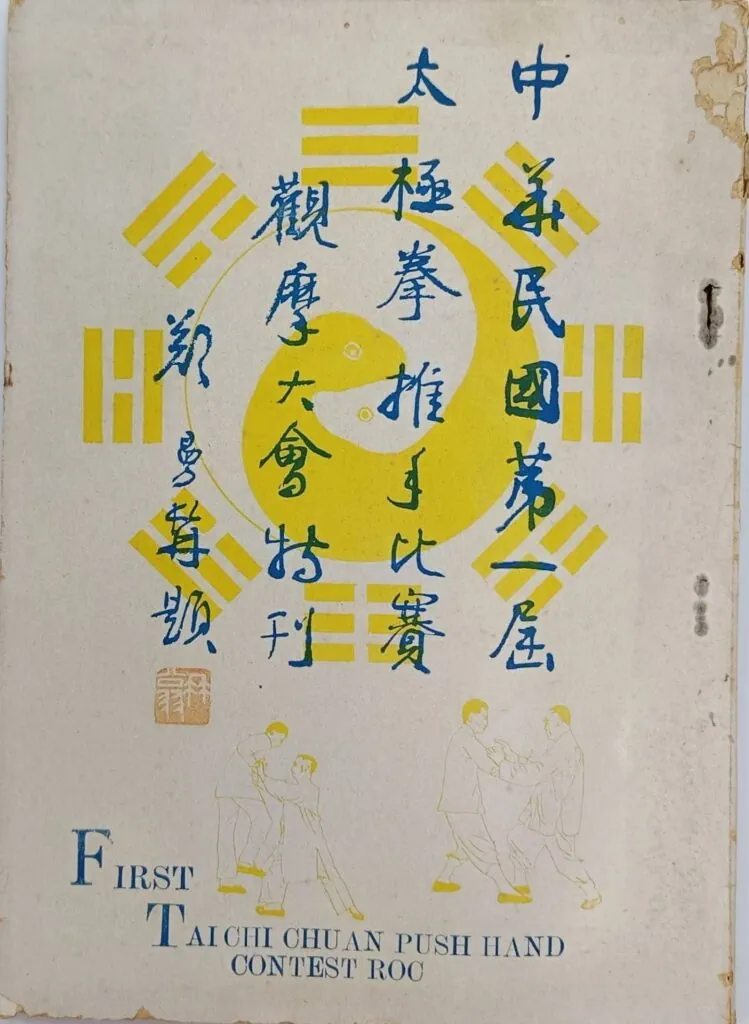
推手比賽觀摩大會
Venue
September 28, 1974
Taiwan Provincial Tobacco and Wine Monopoly Bureau Gymnasium
Description
Excerpt of Account by Song Zhijian
It had long been Master Mànrán’s wish to see Taijiquan flourish by holding a dedicated, public push hands competition. I recall that five years ago, when I was elected by the Research and Development Committee of the Chinese Taijiquan Academic Research Association to redraft the competition rules, Master Mànrán offered many invaluable suggestions for revision.
In the lead-up to the event, I heard that someone had questioned Master Mànrán, claiming that the name and format of our upcoming competition were inappropriate and could lead to negative consequences—an attempt to dissuade him from supporting our organizing committee. That attempt failed; later, when I asked who the person was, Master Mànrán simply said, “As the Way rises, so too do the demons. Let them do as they please. What can they do to me?”
Inspired by the Master’s spirit, fellow practitioners and Taijiquan groups rallied together: some enthusiastically signed up for competitions and demonstrations, others volunteered to help run the event, and many even spontaneously donated funds or contributed prizes.
Consequently, this unprecedented push hands competition and exhibition finally opened smoothly at 9:00 a.m. on September 28th of last year—Confucius’s birthday.
In his opening remarks, Master Mànrán said: “Taijiquan has been passed down for a thousand years, yet practitioners have traditionally guarded their own schools, keeping their teachings secret and hidden. To witness the opening of such a grand, public competition for the first time is truly a rare privilege. With immense gratification, I wish everyone victory and the event every success.”
The event spanned two days, with sessions held each morning, afternoon, and evening. The schedule for each session allocated two-thirds of the time to competition and one-third to demonstrations. The tui shou matches began with the “fixed-step” method; the “moving-step” method was adopted only during the final rounds—semifinals and finals—for each division.
Demonstrations were limited to bare-hand Taiji forms, sparring or auxiliary movements, and Taiji saber or sword routines (including paired sparring).
Master Mànrán, accompanied by Honorary Presidents Shi and Wang, attended all six sessions punctually to offer their moral support, remaining until the scheduled program concluded. During the push hands matches, Master Mànrán closely observed the competitors’ techniques and the referees’ officiating; he would occasionally smile while stroking his beard or applaud in surprise, nodding in approval whenever a competitor effectively demonstrated Taiji’s principles of “relaxing and neutralizing” (song hua) and “steadfast stability” (ding li).
During breaks, team leaders and competitors would gather around to seek his guidance, and the elder master always provided satisfying and insightful answers.
(Master Mànrán is more commonly known as 鄭曼青, Zheng Manqing, Cheng Man-Ching.)
Excerpt of Account by Zhang Zukuan
I first met my teacher and his master (my shiye) in September 1974 at a Taiji tuishou competition held at the Taiwan Tobacco and Wine Monopoly Bureau gymnasium. My shiye possessed the air of a sage—ethereal, benevolent, and dignified. My teacher demonstrated push hands with a smile; after a few exchanges, he projected his partner outward, and the demonstration concluded with laughter.
As for the competition results, a tall British man with a long reach won both his weight class and the overall championship by simply flicking his opponents’ heads with his hands, knocking them over after just a few movements.
Witnessing this scene inevitably raised questions in my mind about the true nature of push hands competitions. Years later, I heard my teacher explain that my shiye had inscribed the title for the event’s special program at the organizers’ request: “The First Republic of China Taiji Push Hands Competition and Demonstration Meet.” This choice of words revealed that my shiye did not approve of treating Taiji push hands as a competitive sport; he believed it should be viewed as an opportunity for observation and mutual learning.
(Zhang Zukuan’s shiye referenced here is Zheng Manqing.)